Showing posts with label Stotram. Show all posts

Bhagawan Sri Sathya Sai Baba Stotrams

   Bhagawan Sri Sathya Sai Baba Stotrams 


I had an opportunity to attend a Bhajan which was to start at 7.30 PM. They asked us to assemble at 6.30 AM. The Bhjan hall had around 50+ pictures of Sri Sathya Sai Baba of Varing sizes envolped with Swami's Vibhuthi materialized on the pictures. At 6.30 PM the a devotee started chanting several of Swami's Stotrams including Suprabatham, Ashothram etc. It went for well over an hour and Bhajans followed. I wanted to learn those stotrams but not sure where to get the lyrics.
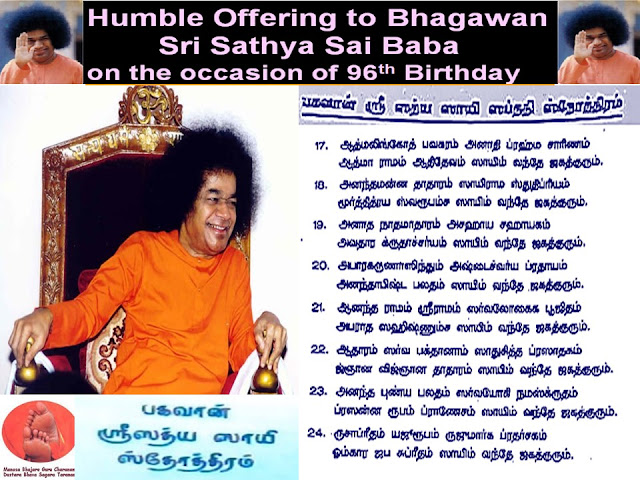
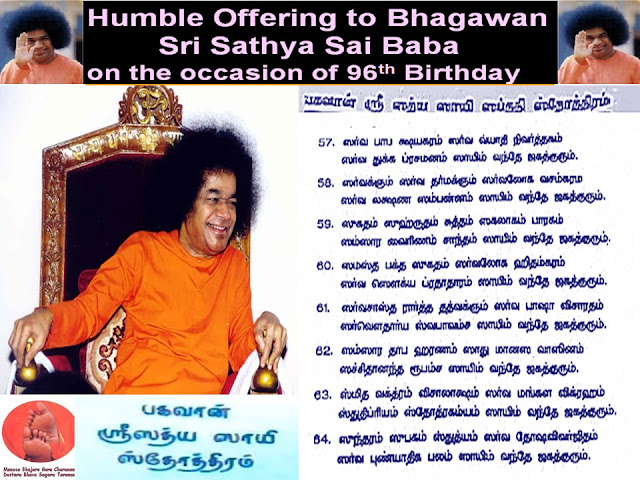
In one of my trips, I bought the publication "Bhagawan Sri Sathya Sai Stothram (Tamil)" from Prashanthi Book store.
That had the lyrics for most of what I heard .
On the Occasion of 96th Birthday, I am happy to offer the following stotrams to Bhagawan Sathya Sai Baba.
The attached Audio link has Stotrams in the following sequence . starts with 21 Aums.
1) Suprabatham
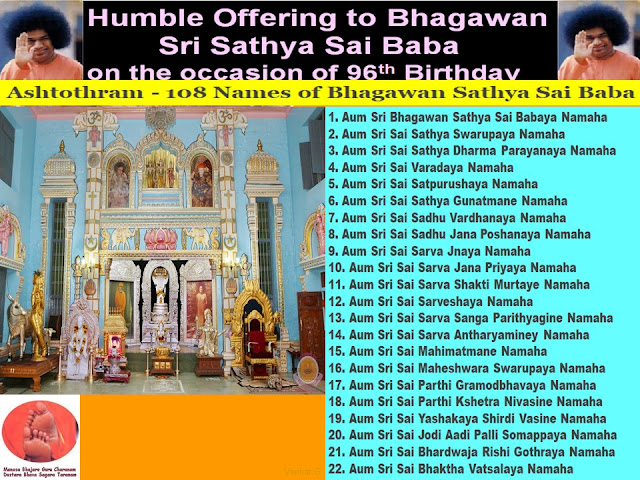
2) Sathya Sai Ashtothram
3) Sai Padma Sai Patham
4) Parthi Nathashtakam*
5) Partheeshwarashtakam*
6) Sharanam Saayeesa Sharanam Partheesa*
7) Saisa Satkam Mantram
8) Sathya Sai Navarathnamala
9) Sathya Sai Stothra
10) Sathya Sai Mangalasasanam
11) Sai Nathashtakam
12) Sathya Sai Praptti Tryam
13) Sathya Sai Pancharatnam
14) Sathya Sai Baba Mahima Stuthi
15) Sathya Sai Saptadi Stotram
16) Sathya Sai Arthi
Note :
Most of Stotrams are from " Bhagawan Sri Sathya Sai Stothram ( Tamil)" a publication of Sathya Sai Trust
Those with * indications are composed by Venkat Govindarajan

C


Sri Sathya Saibaba Ashtothram

 Sri Sathya Saibaba Ashtothram


Sri Satya Saibaba Satkam Mantra

Sri Satya Saibaba Satkam Mantra


Sri Sathya Saibaba Saptathi Stotram

 Sri Sathya Saibaba Saptathi Stotram


Bhagawan Sri Sathya Baba Mahima Stuti

 Bhagawan Sri Sathya Baba Mahima Stuti


Sri Sathya Saibaba Suprabatham

 Sri Sathya Saibaba Suprabatham


Sri Sai Naathashtakam

 Sri Sai Naathashtakam


Sri Sathya Sai Stotram (Karuna Bharana)

 Sri Sathya Sai Stotram  (Karuna Bharana) 


Sri Sathya Sai Prapatti Thrayam

 Sri Sathya Sai Prapatti Thrayam


Sri Sathya Saibaba Patham Sai Patham

 Sri Sathya Saibaba Patham Sai Patham


Sri Sathya Saibaba Mangala Aarthi

 Sri Sathya Saibaba Mangala Aarthi


Bhagwan Sri Sathya Sai Pancharatnam Stotram

Bhagwan Sri Sathya Sai Pancharatnam Stotram


Shirdi Sai Baba's 100th Mahasamadhi (18th Oct 2018) Shirdishwarashtakam

Shirdi Sai Baba's 100th Mahasamadhi

Wikipedia says 

Quote
Sai Baba of Shirdi, also known as Shirdi Sai Baba, was an Indian spiritual master who is regarded by his devotees as a saint, a fakir, a satguru and an incarnation (avatar) of Lord Shiva and Dattatreya. He is revered by both his Hindu and Muslim devotees during, as well as after his lifetime. Saibaba is now revered as incarnation of Sri Dattatreya, and considered as Saguna Brahma. He is attributed to be the creator, sustainer and destroyer of this universe by his devotees. He is decorated with jewels and all forms of Hindu vedic deities as he is supreme God. 
According to accounts from his life, he preached the importance of realization of the self, and criticized love towards perishable things. His teachings concentrate on a moral code of love, forgiveness, helping others, charity, contentment, inner peace, and devotion to the God and guru. He stressed the importance of surrender to the true Satguru, who, having trod the path to divine consciousness, will lead the disciple through the jungle of spiritual training.[3]

Sai Baba also condemned distinction based on religion or caste. It remains unclear if he was a Muslim or a Hindu. This, however, was of no consequence to Sai Baba. His teaching combined elements of Hinduism and Islam: he gave the Hindu name Dwarakamayi to the mosque in which he lived, practised both Hindu and Muslim rituals, taught using words and figures that drew from both traditions, and took samadhi in Shirdi. One of his well-known epigrams, Allah Malik (God is King) and Sabka Malik Ek (Everyone's Master is One), is associated with both Hinduism and Islam. He is also known to have said Look to me, and I shall look to you.
Sai Baba opposed all persecution based on religion or caste. He was an opponent of religious orthodoxy — Christian, Hindu and Muslim.
Sai Baba encouraged his devotees to pray, chant God's name, and read holy scriptures. He told Muslims to study the Qur'anand Hindus to study texts such as the Ramayana, Bhagavad Gita, and Yoga Vasistha. He was impressed by the philosophy of the Bhagavad Gita and encouraged people to follow it in their own lives. He advised his devotees and followers to lead a moral life, help others, love every living being without any discrimination, and develop two important features of character: devotion (Shraddha) and patience (Saburi). He criticised atheism.
In August 1918, Shirdi Sai Baba told some of his devotees that he would soon be "leaving his mortal body" (dying).[28] Towards the end of September, he had high fever and stopped eating.[29] As his condition deteriorated, he asked his disciples to recite holy texts to him and continued to meet visitors. On 15th October 1918, he breathed his last. The day coincided with the Hindu calendar date that year for Vijaydashami.

Unquote

Shirdi Sai Birthday

Wikipedia says  Sai Baba's date of birth including his birthplace remains unknown and is debatable due to lack of evidence and no definitive information exists to prove it. Most definitive information about Shirdi Sai Baba tends to be derived from a book called Shri Sai Satcharitra written by a disciple called Hemadpant (also known as Annasaheb Dabholkar / Govind Raghunath) in 1922 in Marathi.[6] The book itself is a compilation based on accounts by his various disciples and Hemadpant's personal observations observing Sai Baba from 1910 onwards.[7]

Sathya Sai Baba of Puttaparthi has recored Shirdi Sai Baba's Birthday in His discourse dated 28th Sep 1991. Sri Sathta Sai Baba say "

"In the former Nizam's dominions, there was a remote village called Pathri. In that village there were a couple named Gangabhavadya and Devagiriamma. They were grieving over the lack of children. In answer to their prayers a son was born on September 28, 1835.
Today is the anniversary of that day. The child was Sai Baba.

His Samadhi (death) occurred on Vijayadasami day in 1918. September 28, 1835 was his date of birth. On Vijayadasami day, he gave up his body. Although this year Vijayadasami falls on September 29th, in the year of Baba's Samadhi the date was different.

"The first advent of Sai was in Maharashtra. The second advent will be in Madras," Shirdi Baba said. It should be noted that when this form (Sathya Sai) made its advent, Andhra Pradesh was part of Madras Presidency. When he was asked, in what form the next advent would take place, Shirdi Baba told Abdul Baba alone: "I will give darsan in the name of Sathya for upholding Truth." That is the present advent.

The two bodies are different, but the Divinity is one. The first advent was revealing Divinity. The second advent is to awaken the Divinity (in human beings). The next advent is for propagating Divinity. The three Sai's are: Shirdi Sai, Sathya Sai and Prema Sai.

The reason for relating all this is that today happens to be the birthday of Shirdi Baba (September 28,1835). He attained Samadhi in 1918. Bodies are transient. These vestures are assumed only for the sake of devotees. Unless the Divine comes with a form, no one
can develop faith in the Formless. The Divine in human form is the preparation for comprehending the Formless Absolute."


May Shirdi and Sathya Sai bless all.

Here is a poem on Shirdi Sai Baba on the lines of Lingashtakam tune.


மறவாதிரு மனமே சாயிநாதனை

 மறவாதிரு மனமே சாயிநாதனை